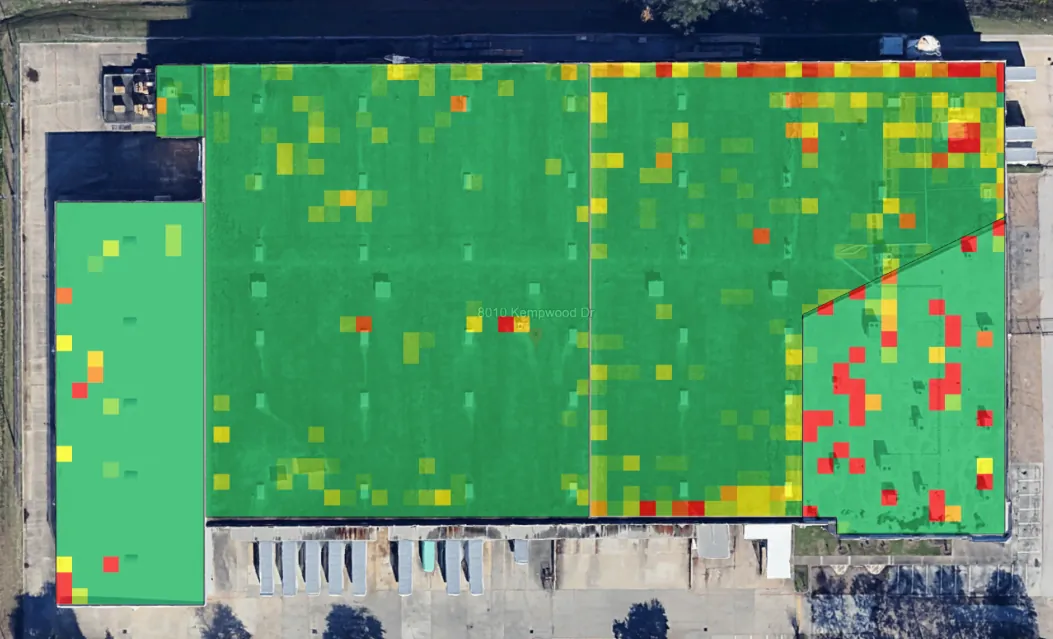
A roof moisture scan maps where water may be trapped inside the roof, across the whole surface, so repair, restoration or replacement decisions are based on data instead of guesswork.
Water that gets into a roof does not always show up as a ceiling stain. It can sit in the insulation for years, adding weight, reducing insulating value and making a restoration unworkable. A moisture assessment helps find it.
What Roof MRI is
Roof MRI is a moisture detection method from ReDry LLC. The roof is scanned with an impedance scanner on a 10 x 10 ft grid, readings are confirmed with a moisture probe, and the results are mapped over an aerial image of the roof (Roof MRI). Structure performs these scans for Houston commercial roofs. See how a Structure Roof MRI scan works.
Reading a color-coded moisture map
A Roof MRI report classifies every square of the roof into one of four categories and totals each by square footage and percent of the roof.
- Dry. No meaningful moisture detected.
- Damp. Elevated moisture that is developing and worth watching or addressing.
- Wet. Active moisture in the insulation that typically needs to be removed or dried.
- Undetermined. Areas the scan could not conclusively evaluate.
What it helps decide
- Whether a roof is a realistic restoration candidate.
- Which sections may need wet insulation removed and replaced.
- Where to focus repairs and what to budget.
- A documented baseline to compare against in future scans.
About drying a wet roof
Some providers dry limited wet areas in place using vents placed in the wet zones, then rescan to confirm moisture is declining, as ReDry describes. It is not right for every roof. Vents require penetrations, drying takes time, and widespread saturation or deck damage usually means the wet material has to come out. Ask us whether it is worth evaluating for your roof.
A moisture scan is one input. Final recommendations require an onsite assessment of the whole roof. See pricing or request an assessment.
Quick answers
Does a moisture scan damage the roof?
The Roof MRI scanner does not penetrate the roof. A small number of pin-prick probe readings confirm and calibrate the results, and core samples may be recommended when findings will drive a major decision.
Can a wet roof be dried out instead of replaced?
Sometimes. Where moisture is limited and the roof is otherwise sound, in-place drying with vents may be an option, verified by follow-up scans. Drying vents require penetrations, and not every wet roof can be saved. Widespread saturation or deck damage usually means removal.
Is a moisture scan required before restoration?
Restoring over wet insulation traps the moisture in, so understanding moisture is an important part of deciding whether restoration fits.