The criteria for choosing between restoring a commercial roof and replacing it, in the order they should be checked, with the thresholds sources use and the signs that tip the decision each way.
Choosing between roof restoration or replacement mostly comes down to what’s under the surface. If the structure is sound, the insulation is mostly dry and the problems can be repaired, restoration is usually worth pricing. If moisture is widespread, the deck is deteriorating or the roof is already past the end of its service life, a coating won’t fix it, and replacement is the honest answer.
Restoration here means repairing the existing low-slope roof and covering it with a liquid-applied coating such as acrylic, silicone or polyurethane, so the old roof stays in place. Replacement means tearing the old roof off and installing a new system. The checks below are in the order a careful contractor runs them, because an early no makes the later questions moot.
Roof restoration or replacement: the criteria in order
1. Is the structure sound?
Coatings are made for an existing, structurally sound roof, and they can’t fix a deteriorated deck. If you can, look at the underside of the roof deck from inside the building. Water stains, holes, rusted metal deck, or rotted or cracked decking are all warning signs, and ponding on top can point to a deck that’s sagging.
If there’s evidence of structural failure, or you plan to add heavy equipment such as condensing units or blowers, bring in a licensed structural engineer before deciding anything.
2. How much of the roof is wet?
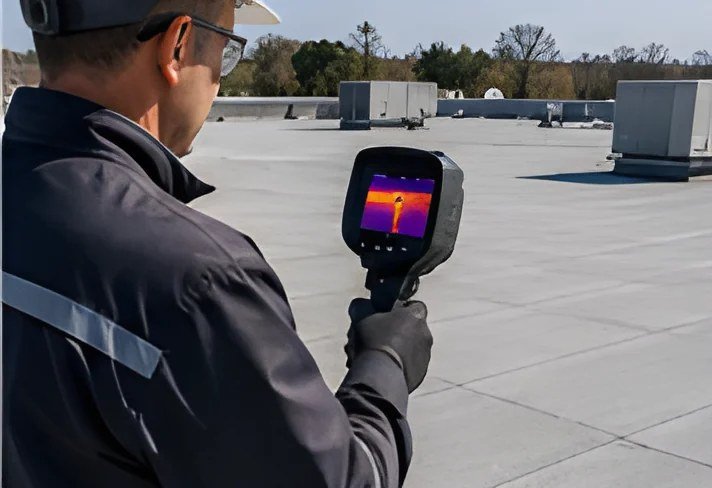
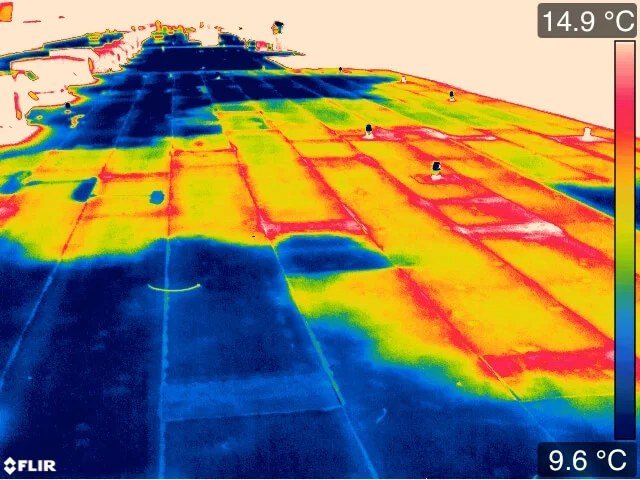
This is usually the deciding question. Wet insulation under a membrane can’t be seen, though a soft spot underfoot is a hint. It’s found with a moisture survey: infrared thermography, with a handheld camera on smaller roofs or from the air on very large ones. Core cuts, small samples cut through the roof, confirm what the scan shows and reveal how many roofing layers are already there.
A handheld infrared camera finds wet insulation the eye can’t see. Core cuts confirm what it shows.
If any of these terms are new, the roofing glossary explains them with photos.
Sources put the cutoff in roughly the same place. One coatings manufacturer says a complete tear-off may be considered once moisture shows up in 25% or more of the roof area. A coatings manufacturer’s technical manager says roofs 20% to 25% (or more) saturated will likely need full replacement, and a third source calls restoration generally cost-effective when 25% or less of the roof needs replacing.
Below that line, the wet areas are cut out and replaced as part of the restoration. Above it, you’re usually paying to patch more roof than you’re keeping.
An infrared scan maps where a roof may be wet, so core cuts can be taken in the right places to confirm it.
3. Can the leaks be fixed?
A coating is not a leak cure. Leaks have to be found, repaired and dried out before anything is applied. Persistent leaks in several areas that repairs haven’t solved point toward replacement.
4. Does the roof drain?
Some coatings are damaged by standing water, so drainage problems generally need fixing first. Ponding that can’t be resolved is a reason to replace rather than restore.
5. Will a coating stick?
An adhesion test on the existing surface shows whether a coating will bond to it. If adhesion, moisture or detailing problems can’t be brought back to a sound baseline, restoration isn’t viable.
6. How many roofs are already up there?
Building codes limit stacking new roofs on old ones. Under model code language, a new roof covering can’t go over an existing roof that’s water-soaked or too deteriorated to serve as a base, or over a roof that already has two or more coverings. In those cases replacement means removing every layer down to the deck, and the core cuts tell you which case you’re in.
7. How long do you need the building?
A building you expect to sell or take down in a few years may not need a long-term fix, while one you’ll own for decades does. If an expansion is planned, reroofing at the same time is generally more economical than splitting the work across years.
What tips the decision toward restoration
The deck is sound and the damage and saturation are low to moderate.
The leaks have been found and can be repaired.
The roof drains, or its drainage can be corrected.
The existing surface passes an adhesion test.
The roof still has service life left. A coating can help extend the life of a sound roof, but it can’t add life back to one that’s already worn out.
When those line up, restoration generally costs less than a tear-off and replacement, and the existing roof stays in service. That’s the window of opportunity, and it closes as the roof degrades.
What tips it toward replacement
Wet insulation or saturated substrate across a large share of the roof.
Significant deck deterioration or other structural problems.
Leaks in multiple areas that repairs haven’t solved.
A roof that’s at the end of its service life.
Ponding that can’t be resolved.
Two or more roof coverings already in place.
The honest version: when restoration is the wrong purchase
Restoration is the cheaper option, which makes it easy to sell to a roof that doesn’t qualify. A coating can’t fix wet insulation or a failing deck, and it can’t add life back to a roof that’s worn out. If a contractor quotes a coating without a moisture survey, core cuts or an adhesion test, you’re being asked to take the roof’s condition on faith.
The cutoffs above also deserve some skepticism. All three come from companies that sell coatings, and where your roof actually falls depends on the survey, your local code and the warranty you want, since some warranties set their own moisture limits. Treat the 25% figures as a guide, not a rule.
What we do
Before we recommend anything, we work out what’s actually on your roof and what you need from the building.
Ask questions first. How old is the roof, what system is it, and is it still under warranty? What repairs have been done, and where has it leaked? We also ask how long you plan to own the building, and whether an expansion or new rooftop equipment is coming, because both change the answer.
Investigate from below. Where we can get access, we look at the underside of the roof deck for water stains, holes, rusted metal deck and deterioration.
Investigate from above. We walk the roof looking for cracking, exposed reinforcement, blisters, plies separating, weak seams, flashings, drains and ponding.
Find the water. An infrared moisture survey shows where the insulation may be wet. Core cuts confirm it and tell us how many roof layers are already there. Where it matters, an adhesion test shows whether the existing surface is sound.
Put it in writing. Our roof system analysis lays out what we found, with the scans and core results, and what each finding means for the restore-or-replace decision. If the findings point to a structural engineer, we’ll tell you that too.
Questions to ask before you sign either proposal
What did the moisture survey find, and can I see the scan?
How many core cuts were taken, and how many roof layers are there?
Was adhesion tested, and where?
Which wet areas will be removed and replaced, and how much of the roof is that?
What warranty comes with the work, and what does it require from me?
Not sure whether your roof can be restored?
Request a roof inspection, and see the moisture survey before you decide.