A plain-language comparison of the two most common single-ply roof membranes on Houston commercial buildings: how they differ, where each one loses, and how to tell which one fits your roof.
Choosing between TPO vs. PVC usually comes down to one question: does anything greasy, oily or chemical land on your roof? If it does, PVC is the safer choice because it resists those substances and TPO doesn’t. If it doesn’t, TPO is generally the more affordable option and performs well on large, simple roofs like warehouses, offices and retail buildings.
Both are white, single-ply membranes with heat-welded seams, and from the parking lot you can’t tell them apart. The differences are in what they’re made of, how they age, and what they tolerate. Here’s how they compare, where each one loses, and how to decide.
What are TPO and PVC?
Both are single-ply roofing membranes: one layer of flexible sheet laid over insulation and either fastened or glued down. If a term here is unfamiliar, the roofing glossary has a plain definition and a photo.
PVC (polyvinyl chloride) was the original weldable roofing sheet and has the longer track record of the two. It contains plasticizers, additives that keep the sheet flexible.
TPO (thermoplastic polyolefin) is the newer membrane and has taken a large share of the commercial market. It’s made from a polypropylene and ethylene-propylene blend and doesn’t need plasticizers to stay flexible.
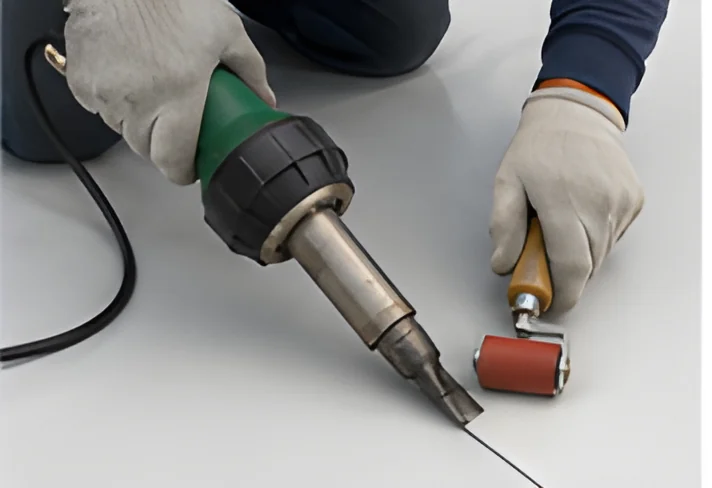
Both have seams welded with hot air into one continuous sheet, both come in white reflective versions, and both can be mechanically fastened or fully adhered.
How TPO vs. PVC compare on a Houston roof
Grease, oil and chemicals
This is the biggest difference between them. PVC resists oils and grease, which is why it’s the usual choice for restaurants and roofs with grease exposure. TPO doesn’t resist greases and oils, and it can also be sensitive to certain cleaning agents and chemically treated HVAC condensate. A TPO roof downwind of a kitchen exhaust fan will wear faster than the rest of the roof.
Fire
PVC is the more fire-resistant of the two, and some PVC membranes carry Class A fire ratings. If fire performance matters for your building or your insurer, ask for the rating of the specific assembly being proposed rather than the membrane alone.
Flexibility and detail work
PVC is more flexible than TPO. That makes it easier to work around complex details such as curbs, pipes and odd transitions. TPO needs higher welding temperatures, but both membranes weld well in the hands of an experienced crew.
TPO and PVC are both heat-welded at the seams. The weld quality matters more than which membrane you pick.
How they age
Both have had problems in the past, and both have improved. Older PVC formulations lost plasticizer over time, which made the sheet stiffer and caused shrinkage. Some TPO has also shown shrinkage that stresses the seams, and low-quality TPO can age early. Newer formulations of both are better than what was on roofs twenty years ago.
An aged PVC membrane. Older PVC formulations lost plasticizer over time, which left the sheet stiff and prone to cracking.
Durability and punctures
This is where the sources disagree. A TPO manufacturer’s own heat-aging tests give TPO the edge on weathering and slightly better tear resistance. A roofing contractor’s comparison describes PVC as more resistant to punctures and TPO as more vulnerable to foot traffic. Treat any claim of a clear winner here with some caution.
Wind
How the membrane is attached matters more than which membrane it is. A mechanically fastened sheet is held down in rows of screws and plates, and it can billow between those rows in high wind. A fully adhered sheet is bonded across the whole surface. On the Gulf Coast, ask what wind uplift rating the full assembly is designed to meet.
Reroofing over an old roof
PVC can’t be in contact with asphalt-based materials. If you’re reroofing over an old built-up or modified bitumen roof, a PVC system needs a separation layer, and that should be in the scope.
Cost
TPO is generally the more affordable of the two. On a large roof with no grease or chemical exposure, that difference is the main reason most building owners end up with TPO.
Which one should you choose?
Choose TPO if your roof is large and fairly simple, nothing greasy or chemical reaches it, and you want the lower installed cost. Where it loses: grease and oil exposure, some cleaning agents and treated condensate, and fire performance.
Choose PVC if your building is a restaurant, food processor or manufacturing plant, or any roof that sees grease, oils or chemicals, or if the roof has a lot of complex detailing. Where it loses: it costs more than TPO, it can’t touch asphalt-based materials, and on a plain office roof its advantages may never come into play.
The honest version: when the choice matters less than you think
Neither membrane is better across the board. PVC’s extra cost buys you grease, chemical and fire resistance, and if your roof never sees grease or chemicals, you may be paying for protection you’ll never use. TPO quality varies from one formulation to the next, so the brand and the specific product matter more than the letters T-P-O.
The manufacturers’ own studies disagree about which one lasts longer, so be wary of any sales rep who says the answer is obvious. On most roofs, the quality of the seam welds and the flashing details will decide how long the roof lasts more than the choice of membrane.
And on a small roof crowded with pipes, curbs and equipment, neither single-ply may be the right system at all. Other systems often handle that kind of roof better, and a good contractor should tell you that.
What we do
Look at what reaches your roof. Kitchen exhaust, process exhaust, chemical storage and treated condensate lines usually decide the TPO vs. PVC question on their own.
Check what’s underneath. How many layers are there, is any of it asphalt-based, and is the insulation dry? A moisture survey and a few core cuts answer that.
Count the details. A roof with dozens of penetrations and curbs may be better served by a different system entirely, and we’d tell you that.
Put the options side by side, or tell you to wait. If your current roof has good years left with routine repairs, that’s what we’ll tell you, and our roof system analysis lays it out in writing.
Questions to ask any contractor quoting TPO or PVC
Which manufacturer and which specific product are you quoting?
Is it mechanically fastened or fully adhered, and what wind uplift rating does the assembly meet?
For PVC over an old roof: what separates the membrane from any asphalt-based material?
For TPO: is there grease, chemical exposure or treated condensate on my roof that rules it out?
Who welds the seams, and how are the welds checked?
Not sure whether your roof needs TPO or PVC?
We will look at what reaches your roof, check what is underneath, and tell you plainly what fits.